01Buying question
Does three-zone heating establish a completed cure?
Cure depends on the material and its actual time-temperature history. Agree the material acceptance method and obtain a profile with the loaded product.
SMT equipment sourcing · inspection · packing · global delivery

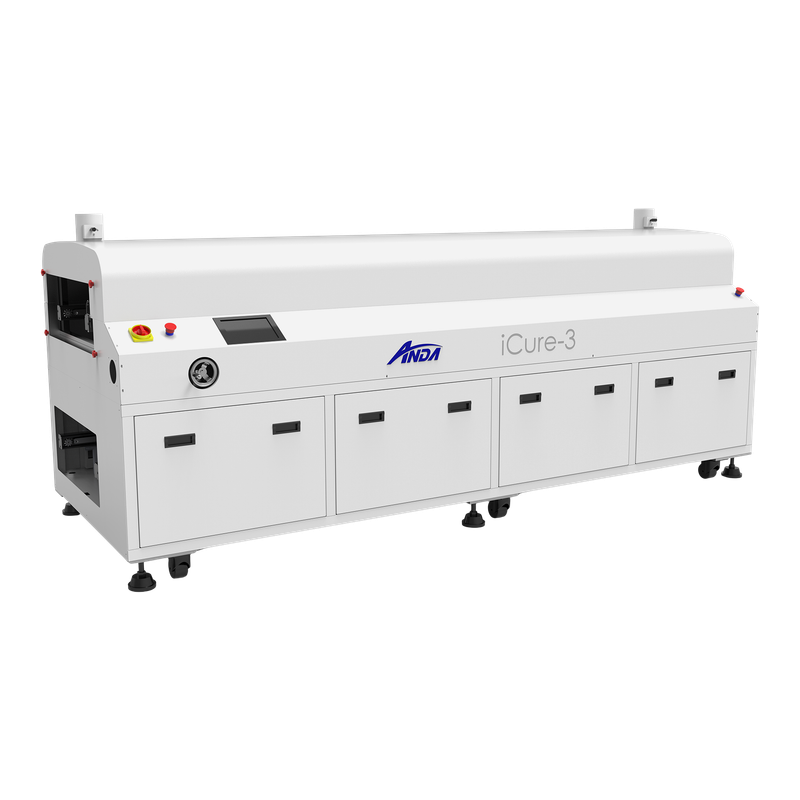
Match an inline infrared curing oven to the adhesive or coating recipe, the loaded carrier and the required residence time. Anda identifies iCure-3 as the three-zone member of its iCure range. Its value depends on the temperature reached by the material throughout the run and on a conveyor arrangement that supports the real assembly.
| Published process | Infrared curing of heat-curable coatings, adhesives and inks |
|---|---|
| Heating zones | Three independently controlled zones for iCure-3 |
| Published temperature range | Ambient to 100 °C in the mainland product table |
| Temperature control reference | ±5 °C as published. This is distinct from measured temperature uniformity on a loaded assembly. |
| Conveyor datum | 900 ±20 mm in both official regional specifications |
| Component clearance | 100 mm above and below the conveyor in the published series specifications |
| Mainland dimensional reference | 3000 ×1070 ×1155 mm for iCure-3. Obtain the current ordered drawing. |
| Utilities | Mainland sheet specifies 380 V, 50 Hz, three-phase five-wire supply |
| Version-dependent items | Conveyor speed, loading, total power and enclosure height differ between regional sheets. Confirm the offered revision. |
Manufacturer information and the matching equipment literature. Manufacturer reference. Confirm the supplied configuration on the quotation.
Start with the material supplier's temperature and time requirements, including the allowed ramp and the condition at which the product can be handled. Compare that window with a measured profile through the oven. A three-zone arrangement can help shape heat input along the conveyor, but a zone setpoint alone does not establish the temperature in a large connector, shielded joint or thick adhesive bead. Give the supplier the substrate, coating thickness and the carrier construction so the trial represents the actual thermal load.
Agree a profile trial using the widest loaded carrier and a thermally demanding assembly. Record conveyor speed, each zone setting, load spacing, sensor positions and ambient conditions. Follow product temperature through entry, heating and discharge. Check restart behaviour after a normal pause and compare isolated carriers with a sustained run. Accept the process against the material's cure criteria, with the required inspection or material test recorded separately from the controller trace.
The mainland specification and the Hong Kong series page agree on the three-zone identity but publish different conveyor-speed, load, power and height figures. Preserve the sheet date with the quotation. Ask which regional revision applies, whether under-conveyor heating is fitted and whether return transport changes the envelope. Use that answer to prepare the utility and floor drawings. Avoid assigning a single maximum load to every iCure-3 merely because the enclosure looks similar.
Calculate a first residence-time estimate from the effective heated length and conveyor speed, then validate it by profiling. If the upstream process releases boards faster than the cure recipe permits, examine spacing and buffering before changing speed. Ask how the line handles a downstream stop with assemblies still inside the oven. Record the permitted recovery or rejection procedure for interrupted material so the operator has a defined disposition.
An IR oven is a candidate when the material is specified for thermal curing and the assembly can tolerate the required exposure. A UV process needs a compatible UV-curable material and a suitable optical path. A hot-air or vertical arrangement changes heat transfer, handling and floor use. Compare these choices with the same assembly and cure requirement. Useful evidence includes product-temperature traces and the resulting material condition under the specified test.
Supply carrier dimensions, gross weight per metre of occupied conveyor, component clearances, travel direction and the required interface. Describe whether the product is tacky at entry and whether contact beneath the board is restricted. Include the exhaust destination and local electrical requirements. Ask the seller to identify the exact power rating, conveyor adjustment and installed options in the offer, with a current drawing that can be checked before shipment.
Ask for a continuous loaded transfer and heating demonstration, together with the temperature settings and alarm response. Add an independently reviewed product-temperature profile to evaluate the material recipe.
Have a qualified technician inspect the conveyor chain, rail adjustment, heater modules, temperature sensing and exhaust condition. With the oven safely isolated and cool, look for deposits, damaged insulation, loose supports and worn moving parts. Ask for the model-specific cleaning procedure and heater replacement references. After work on a temperature sensor, heater or conveyor drive, verify the relevant settings and repeat a representative thermal profile before returning the recipe to production.
Include the following when asking for a configuration and acceptance plan.
Common questions when selecting Anda iCure-3 Inline Infrared Curing Oven for your line.
Cure depends on the material and its actual time-temperature history. Agree the material acceptance method and obtain a profile with the loaded product.
The reviewed regional sheets differ. Request a signed specification for the offered revision and keep the chosen speed tied to the validated recipe.
Only a process and material review can establish that. Confirm the material's curing mechanism and required properties before selecting a different heating method.
Show the identified machine, conveyor adjustment, loaded transfer, temperature settings, alarms and a restart. A separate temperature record is needed to evaluate the cure profile.
Anda's mainland website lists the iCure-2, iCure-3 and iCure-4 range and gives its Dongguan address. Request revision, availability and delivery terms for the specific order.
Check the applicable model revision and the offered configuration when using these references.
Agree the packed dimensions, handling points and protection for exposed interfaces before arranging freight. Ask for the packing list with loose tools and accessories identified so they can be checked at receiving.
Share the application, dimensions and acceptance requirements. Ask for the fitted configuration, utility drawing and delivery scope.