
Buyer decision 1
Start below the board
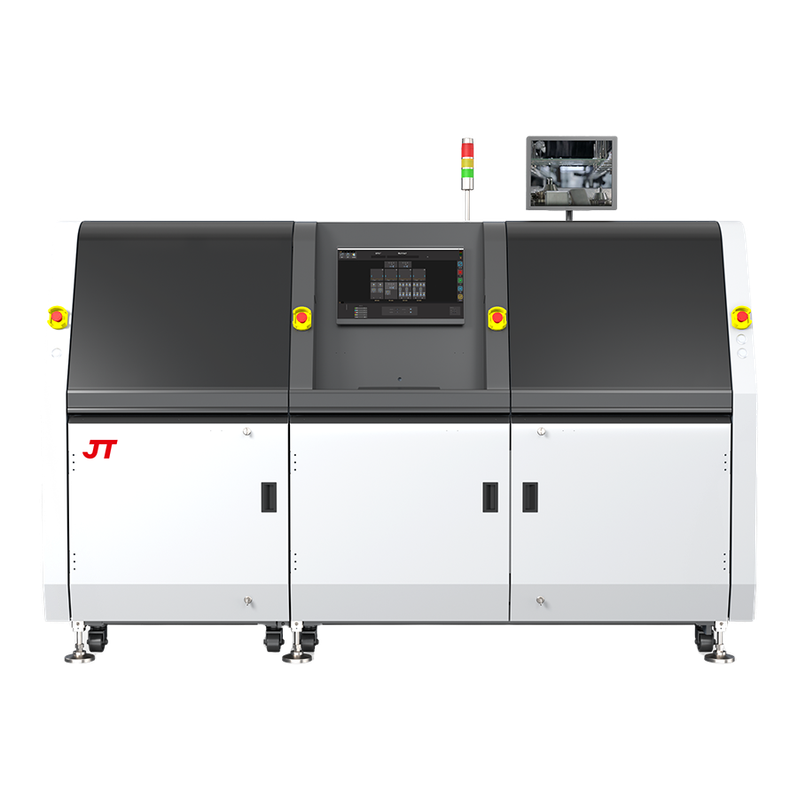
A selective soldering quotation is only useful if the proposed nozzle can reach the required joints without interfering with nearby parts or fixtures. Begin with a bottom-side drawing, populated board and marked solder targets. JT describes NIS as an integrated flux/preheat/selective process with two pots and independent lifting. This is model context, not proof that the installed nozzle set fits your assembly. Board width alone cannot resolve one obstructed connector.
Buyer decision 2
Create a joint-by-joint access map
Identify target pads, protruding leads, neighboring components, fixture walls, conveyor support and keep-out regions. Ask the supplier to propose a nozzle and motion path for each difficult location, then explain any inaccessible or high-risk joint. Verify the map against the physical sample because a drawing can omit protrusions or fixture details. Keep the nozzle identification and board revision in the trial record. Do not label a path safe merely because it appears unobstructed in a remote photograph.
Buyer decision 3
Account for the whole thermal sequence
Record the fluxing method, preheater configuration and soldering recipe selected for the actual materials. Set process limits with the responsible engineer and material instructions. Request measured evidence from appropriate locations on the representative assembly, not only pot and heater setpoints. Where the first and last joint experience different waiting times, keep their sequence visible. No universal temperature, dwell or defect-rate limit is asserted here: such limits depend on the assembly and approved process.
Buyer decision 4
Keep two-pot capability separate from throughput
Ask how the proposed program allocates the two pots and whether the installed configuration supports the intended sequence. Time loading, fluxing, preheat, travel, soldering, transfer and recovery as a complete cycle. Include the difficult joint rather than replacing it with an easy demonstration. Two pots do not automatically halve cycle time when access, thermal preparation or transport remains the bottleneck. Keep any promised rate tied to a documented board and installed configuration.
Buyer decision 5
Preserve the program and inspection result
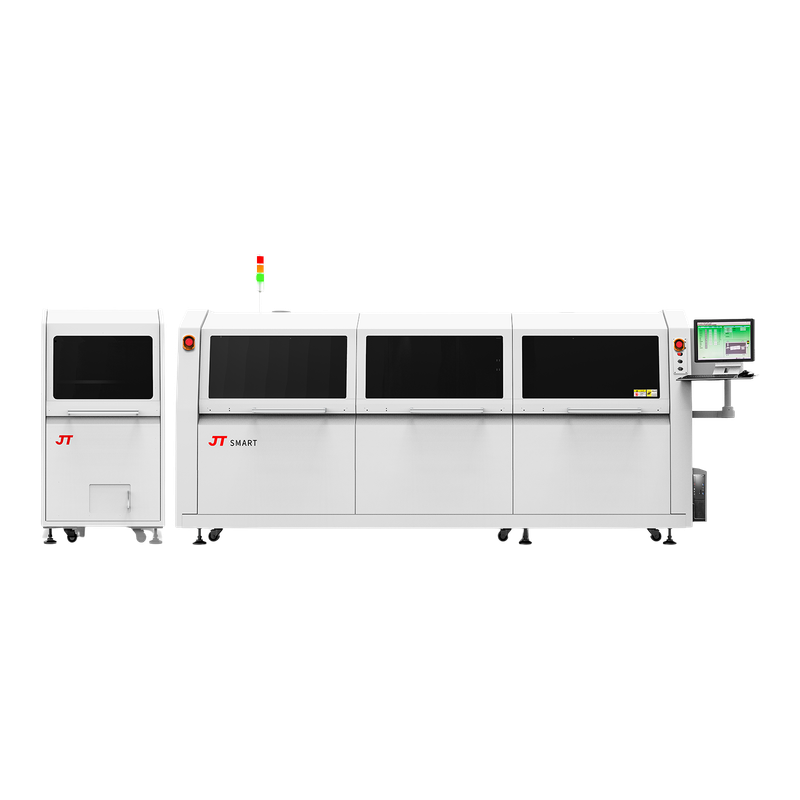
Request the imported board data, program revision, nozzle positions, installed configuration and a dated operating sequence. The manufacturer-described CCD view can show process activity, but it is not by itself an inspection of every joint or an electrical test. Keep the buyer-approved joint assessment alongside any process view. Record failed samples and setting changes. If a catalogue value has an inconsistent unit, obtain a corrected manufacturer document rather than silently guessing its intended numerical limit.
Buyer decision 6
Use the map as a purchase condition
A defensible comparison contains the access map, nozzle proposal, measured thermal sequence, complete cycle and joint-inspection evidence for the chosen assembly. Common mistakes are selecting by maximum board size, treating a double-pot headline as a finished-board rate, or using a camera view as proof of hidden-joint quality. Changes in fixture, lead geometry, material or program can invalidate the trial. Keep unresolved access and inspection issues as explicit conditions before accepting a machine.
Technical Sources
Manufacturer context and limits
Checked 4 October 2026. Published model facts support the examples; the acceptance framework is buyer guidance, not claimed LCSMT field-test evidence.