Printer selection
Start with the material, not the speed
Write down whether the job prints a conventional PCB, a Mini LED substrate, a singulated package or a wafer. Record substrate and carrier dimensions, stencil frame, paste, aperture geometry and support points. A model name can narrow the search, but it does not establish process capability or fit for a particular board.
Printer selection
Screen standard-board printers by envelope
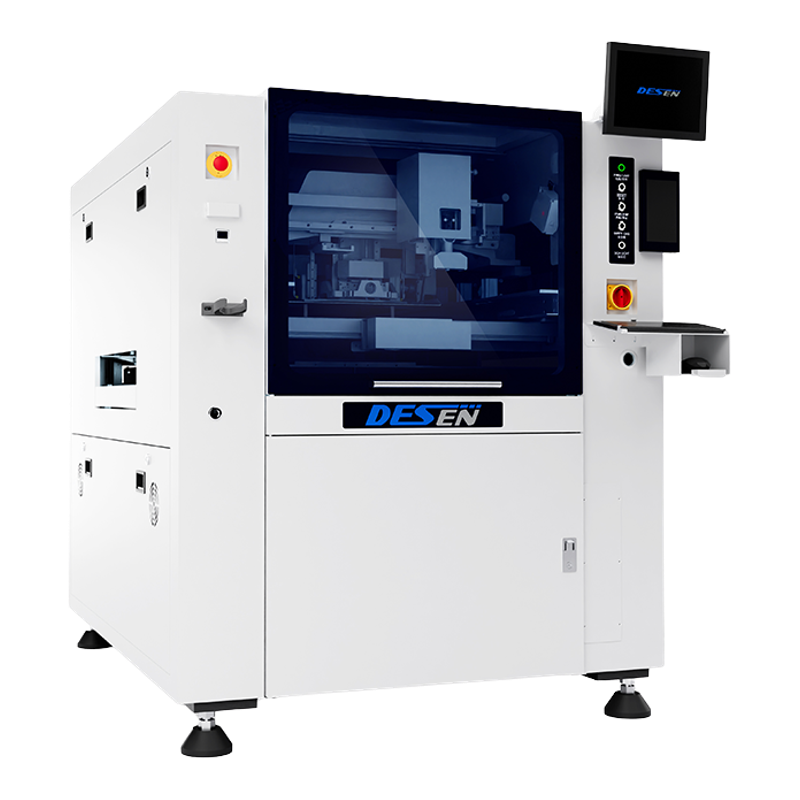
DESEN publishes a maximum substrate of 400 × 340 mm for Hito and 510 × 510 mm for Classic 510A. Compare the full board or carrier drawing with those limits and then ask for the actual unit's stencil, support, cleaning and camera configuration. A 510 mm catalogue limit alone cannot establish edge clearance or stable support.
Printer selection
Separate Mini LED and dual-platform needs
DESEN lists DSP-Mini LED Plus2 with a 510 × 510 mm maximum substrate, dual-drive squeegee lift and small-platform adjustment. It lists DSP-DT with a 510 × 510 mm maximum and dual-platform printing. The former calls for a print trial against the Mini LED pad and paste specification; the latter calls for a board-flow trial including both platforms, transfer and cleaning. Neither product label proves yield or doubles output.
Printer selection
Treat advanced packaging as a different process
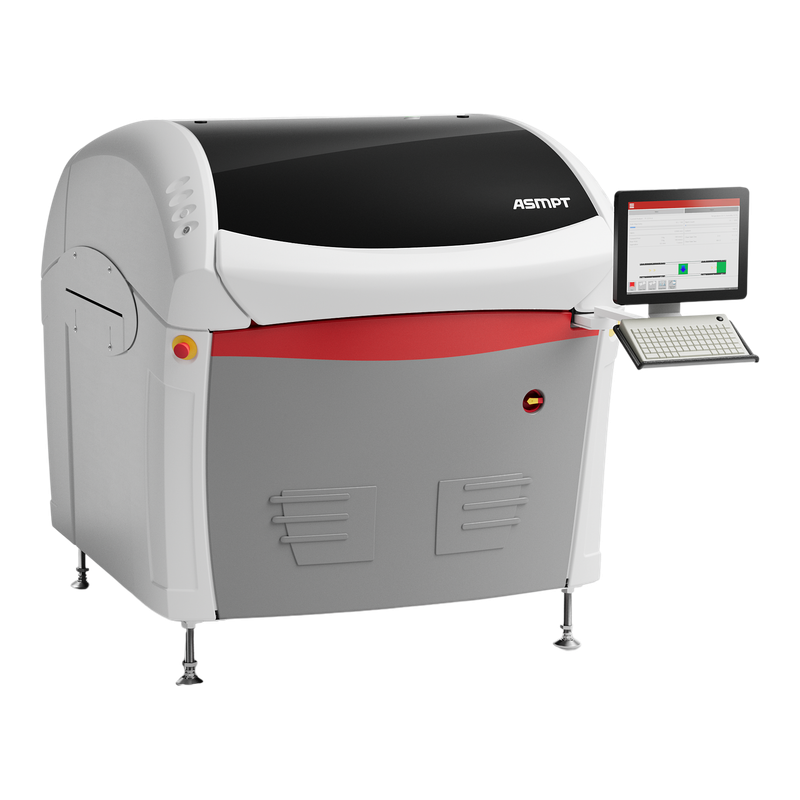
ASMPT's DEK Galaxy lists a 600 × 508.5 mm print area and 620 × 508.5 mm maximum substrate. Its published wet-print capability is greater than 2.0 cpk at ±17.5 µm, distinct from the ±12.5 µm alignment figure. Wafer bumping and singulated-substrate work may require particular tooling. Identify the installed fixtures and request a representative acceptance print.
Printer selection
Request evidence for the exact machine
For every shortlisted printer, request a model plate, installed-option list, exact-unit photos, software and voltage details, stencil and support inventory, and a trial with representative material. Record deposit inspection results, repeatability, transfer and cleaning time separately. Manufacturer specifications are screening references; they do not prove stock, used-unit condition or a finished line rate.
Technical sources
Manufacturer model pages
https://www.desen-sz.com/biaozhunyinshuaji/69-55.html
https://www.desen-sz.com/biaozhunyinshuaji/69-89.html
https://www.desen-sz.com/miniyinshuaji/70-92.html
https://www.desen-sz.com/shuangpingtaiyinshuaji/71-93.html
https://smt.asmpt.com/en/products/printing-solutions/dek-galaxy/